September 15, 2026
Nine findings from watching ChatGPT pick cash flow forecasting software
ChatGPT reads far more than it cites. “We don’t show up in AI” is really four different problems. The next question is which one you have.
I placed every company that showed up as a cash flow forecasting vendor in my 160 ChatGPT runs on a grid. That’s 46 ChatGPT named in its answers plus 41 more whose pages it read along the way.
Not all of them sell cash forecasting software. The grid shows who ChatGPT treated as part of the category, not who is actually in it.
77% of vendors sit in a different cell depending on the question type and this exercise uncovered 9 key findings.
The grid
The number after each name is runs named for the two named cells. For the two cells below them, it’s pages read.
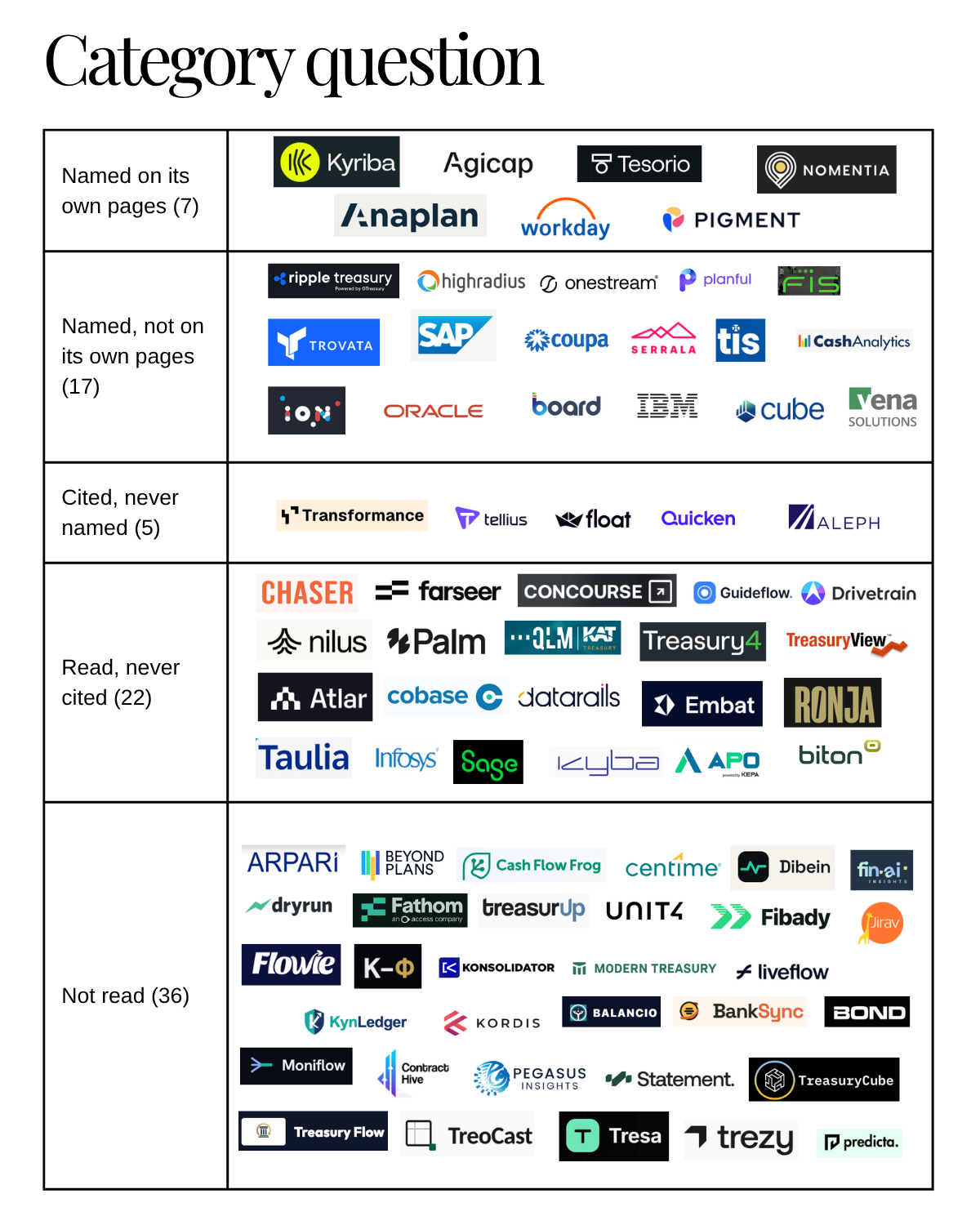
The category question · 80 runs
What a buyer asks when they already know the category. Two phrasings, 40 runs each: “What are the best cash flow forecasting software options for a large finance team?” and “What software should a corporate treasury team consider for cash flow forecasting?”
| Cell | Vendors |
|---|---|
| Named on its own pages (7) | Kyriba 79 · Anaplan 53 · Nomentia 36 · Workday 31 · Pigment 22 · Tesorio 5 · Agicap 1 |
| Named, not on its own pages (17) | GTreasury 52 · Planful 29 · OneStream 27 · HighRadius 26 · FIS 26 · TIS 26 · Trovata 25 · SAP 20 · Coupa 19 · Oracle 19 · ION 11 · Serrala 10 · CashAnalytics 9 · Board 3 · IBM 3 · Cube 2 · Vena 1 |
| Cited, never named (5) | Transformance 95 · Aleph 23 · Tellius 20 · Float 13 · Quicken 9 |
| Read, never cited (22) | Chaser 11 · Farseer 11 · Concourse 8 · Guideflow 6 · Resolut 3 · Taulia 3 · Drivetrain 2 · Nilus 2 · Palm 2 · QLM 2 · Treasury4 2 · TreasuryView 2 · Atlar 1 · Biton 1 · Cobase 1 · Datarails 1 · Embat 1 · Infosys Finacle 1 · Kepa 1 · Kyba 1 · Ronja 1 · Sage 1 |
| Not read (36) | Arpari · Balancio · BankSync · Beyond Plans · Bond Treasury · COMMITLY · Cash Flow Frog · Centime · Cohiva · Consolidate · Dibein · Dryrun · Fathom · Fibady · FinAI Insights · Flowie · Jirav · K-Phi · Konsolidator · Kordis · KynLedger · LiveFlow · Modern Treasury · Moniflow · NextHive · Pegasus Insights · Sphere · Statement · TreasurUp · TreasuryCube · TreasuryFlow · TreoCast · Tresa · Trezy · Unit4 · predicta. |
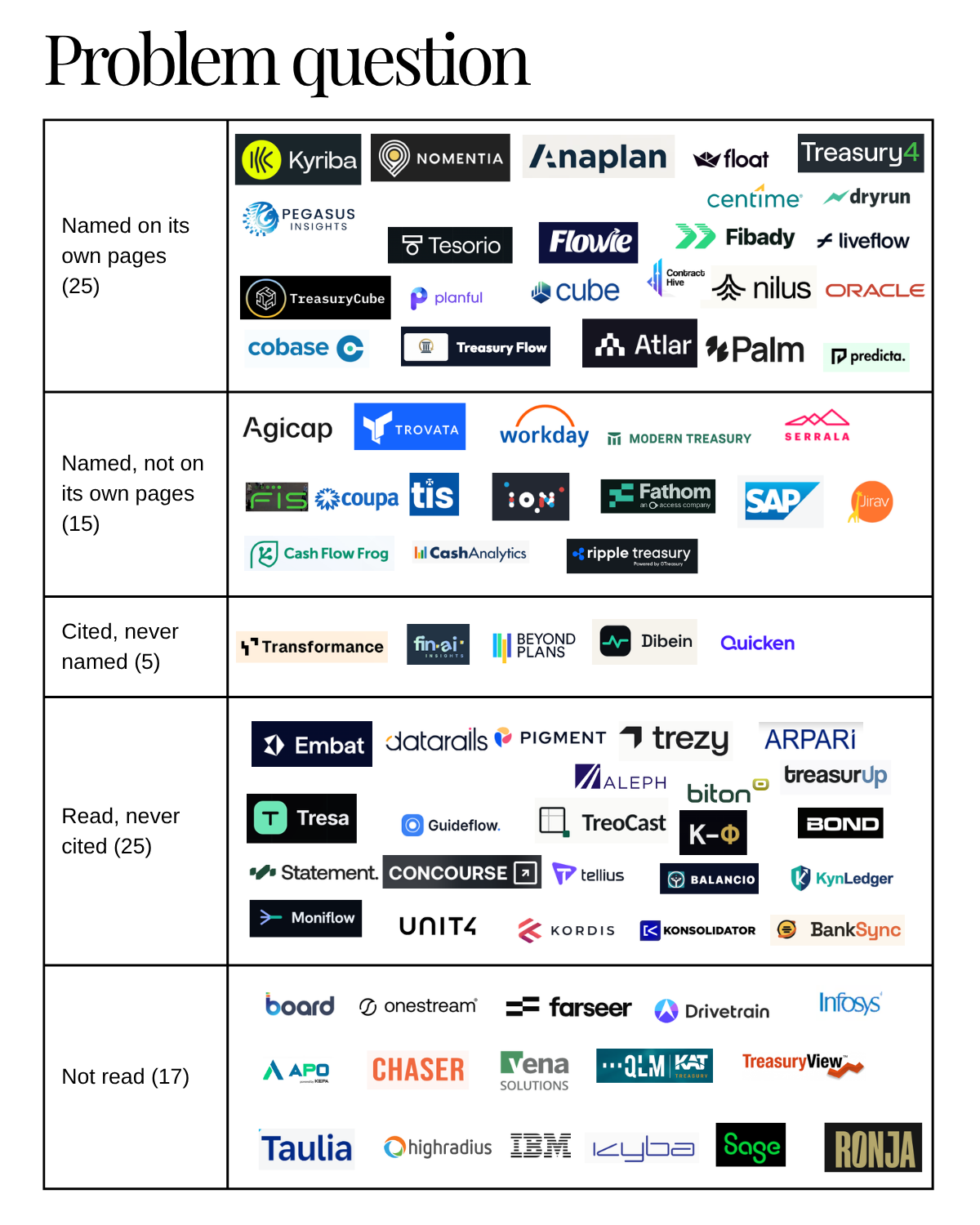
The problem question · 80 runs
What a treasury team asks when it only knows what keeps going wrong. Two phrasings, 40 runs each: “Our 13-week cash flow forecast keeps missing across multiple entities. What tools can help?” and “Our treasury team spends too much time consolidating cash forecasts from many bank accounts. What software could solve this?”
| Cell | Vendors |
|---|---|
| Named on its own pages (25) | Kyriba 63 · Nomentia 39 · Float 33 · Dryrun 30 · predicta. 24 · Pegasus Insights 18 · TreasuryFlow 16 · Flowie 15 · Nilus 15 · Planful 5 · Anaplan 5 · Atlar 4 · Fibady 3 · Treasury4 3 · Centime 3 · Cube 3 · Tesorio 3 · COMMITLY 2 · Cobase 2 · NextHive 1 · Cohiva 1 · LiveFlow 1 · Palm 1 · TreasuryCube 1 · Oracle 1 |
| Named, not on its own pages (15) | GTreasury 19 · Trovata 19 · Agicap 16 · TIS 11 · SAP 8 · FIS 7 · Coupa 6 · Serrala 5 · CashAnalytics 3 · ION 3 · Jirav 2 · Fathom 2 · Workday 1 · Cash Flow Frog 1 · Modern Treasury 1 |
| Cited, never named (5) | Transformance 53 · FinAI Insights 21 · Quicken 19 · Beyond Plans 15 · Dibein 14 |
| Read, never cited (25) | Biton 7 · Guideflow 5 · TreoCast 4 · Balancio 3 · Kordis 3 · Moniflow 3 · Aleph 2 · Bond Treasury 2 · Concourse 2 · TreasurUp 2 · Tresa 2 · Arpari 1 · BankSync 1 · Consolidate 1 · Datarails 1 · Embat 1 · K-Phi 1 · Konsolidator 1 · KynLedger 1 · Pigment 1 · Sphere 1 · Statement 1 · Tellius 1 · Trezy 1 · Unit4 1 |
| Not read (17) | Board · Chaser · Drivetrain · Farseer · HighRadius · IBM · Infosys Finacle · Kepa · Kyba · OneStream · QLM · Resolut · Ronja · Sage · Taulia · TreasuryView · Vena |
How to read the grid
Every vendor lands in exactly one cell per question.
| Cell | What happened | Category question | Problem question |
|---|---|---|---|
| Named on its own pages | ChatGPT named it and at least half the time the footnote was its own page | 7 | 25 |
| Named, not on its own pages | ChatGPT named it, mostly footnoting someone else’s page or nothing | 17 | 15 |
| Cited, never named | its page got a footnote, its product never made the list | 5 | 5 |
| Read, never cited | its pages were read and passed over | 22 | 25 |
| Not read | no page of its own was read on this question | 36 | 17 |
The grid shows where ChatGPT put each vendor in these runs. It says nothing about the products.
How it was measured
160 runs. 80 of the category question and 80 of the problem question, two phrasings each. Every run was a fresh temporary chat on the free tier, with memory off. I captured the answer and ChatGPT’s full View sources panel, which lists every page it read rather than only the ones it footnoted.
A vendor is any company my coding flagged as a software vendor in this category. That is the 46 that ChatGPT named, plus 41 that only showed up as publishers. Pages about a vendor that sit on someone else’s site, like a press release or a LinkedIn page, count as third-party.
Nine findings
1. The question decides who wins, not the vendor
67 of the 87 vendors sit in a different cell on the two questions. Only four are named on their own pages on both: Kyriba, Nomentia, Anaplan and Tesorio.
Interesting cases are the vendors named on one question and not read at all on the other.
| Vendor | Category question | Problem question |
|---|---|---|
| OneStream | named in 27 runs | no page read |
| HighRadius | named in 26 runs | no page read |
| Dryrun | no page read | named in 30 runs |
| predicta. | no page read | named in 24 runs |
| Pegasus Insights | no page read | named in 18 runs |
| TreasuryFlow | no page read | named in 16 runs |
| Flowie | no page read | named in 15 runs |
Same buyer, different question. A company-wide “AI visibility score” can’t be right, because visibility belongs to a question.
2. The problem question leans harder on vendor pages
On the problem question, 304 of 396 namings (77%) came with a page of the vendor’s own in the sources panel. On the category question it was 299 of 535 (56%). The other 236 category namings happened with none of the vendor’s pages read.
So the category question appears to run on reputation and the problem question on pages. Coupa shows the category side. It was named in 19 category runs, 48 of its pages were read and not one was footnoted. GTreasury was named in 52 category runs and footnoted to its own page in 3.
A challenger can’t change its reputation this quarter. It can change its pages, which is why the problem question is where it can compete.
3. Being read isn’t the finish line
Several challengers were read in close to half of the 80 problem-question runs. What happened next varied a lot.
| Vendor | Runs with its page read | Named in those runs |
|---|---|---|
| Dryrun | 32 | 29 (91%) |
| Float | 38 | 33 (87%) |
| predicta. | 33 | 24 (73%) |
| Nilus | 22 | 15 (68%) |
| Pegasus Insights | 35 | 18 (51%) |
| TreasuryFlow | 39 | 16 (41%) |
| Flowie | 37 | 15 (41%) |
| Fibady | 18 | 3 (17%) |
| NextHive | 39 | 1 (3%) |
NextHive was read about as often as Float. Float was named in 33 of those runs, NextHive in one.
Named-when-read is the number to watch. A vendor with a low one doesn’t have a traffic problem. The page was found and didn’t win the slot.
4. Pages that say what they do earn footnotes. Slogans don’t
This is the strongest result in the set, because each comparison sits inside one vendor’s own site. Fame can’t explain the gap.
| Vendor | Footnoted often | Read and never footnoted |
|---|---|---|
| Kyriba | ”Intelligent treasury and cash management solutions” · 97 of 142 reads | ”Proven solutions to elevate liquidity performance” · 0 of 94 |
| TreasuryFlow | ”Multi-Entity Cash Flow Dashboard” · 22 of 40 | ”Your real cash position, and the books to prove it” · 0 of 17 |
Both Kyriba rows count two versions of the same title.
The pages that earn footnotes name the thing a buyer is shopping for. The ones that don’t read like a tagline or a press release. Dryrun’s “Multi-Entity Forecasting” page follows the same pattern, footnoted in 17 of 19 reads.
I captured titles, not page text, so the text may be doing some of the work. The title is the part I can see. Here it lines up with the outcome.
5. Pasting the buyer’s phrase into your title isn’t the trick
The obvious reading of finding 4 is “put the buyer’s words in the title”. The data doesn’t support it.
On the phrasing that contains “13-week”, pages with “13-week” in the title were footnoted less often than pages without it: 16% against 28%.
Float is the clearest case. It was named in 33 of 40 runs of that phrasing. Only 2 of the 142 Float pages read there had “13-week” in the title. The page that earned the footnotes was “Float Cash Flow Forecasting Software | Xero & QBO”. On a plain-language version of the same problem, not one Float page was read and Float was named in 0 of 40.
The match happens when pages get found. Whatever made Float findable on “13-week”, it wasn’t the title.
6. Writing the category guide gets your page cited, not your product named
Three vendors published cash forecasting guides and appear on nobody else’s list: Transformance, Concourse and Palm. They were named once between them in 160 runs.
Transformance is the extreme. 148 of its pages were read across 69 runs and 21 were footnoted. 132 of those pages are software comparisons. It was never named.
Float shows this isn’t only a problem for vendors nobody knows. On the problem question it was named in 33 runs. On the category question its guide, “The Best Cash Flow Forecasting Software For Finance Teams (2026)”, was read 11 times and footnoted once. Float wasn’t named in any of those runs.
Across the grid, 41 vendors were never named on either question. Their pages were read 373 times and footnoted 37 times.
7. Being on other people’s lists tracks with being named
I checked eight cash forecasting guides and who each one lists. Every publisher ranks itself first, so a vendor’s own list tells you nothing. Other people’s lists are a different story.
| On other publishers’ lists | Vendors | Average share of runs named |
|---|---|---|
| none | 4 | 0.2% |
| one | 16 | 8% |
| two | 5 | 18% |
| three or more | 5 | 37% |
The four on nobody else’s list are the four guide publishers from finding 6.
This could be prominence driving both, since well-known vendors get listed and get named. Nomentia is the counterexample: on one other list, named in 47% of runs.
8. A handful of sites supply the independent footnotes
86% of all footnotes point at the named vendors’ own sites. Your own site is the main thing the answer credits.
Independent and review sites supply only 9%. Most of that comes from very few places. erpresearch.com alone supplied 26 of those 68 footnotes, 24 of them on the category question. With G2 and Finantrix, three sites account for 60%.
If you’re working the category question, those are the third-party pages to check first.
9. Being included on competitors’ “alternatives” pages may put you in the answer
Pages titled “X alternatives” or “X vs Y” are everywhere in this category. 325 were read. When one was about a vendor, that vendor was named in that run far more often than usual.
| Vendor the page was about | Pages read | Named in that run | Named on the same question overall |
|---|---|---|---|
| Anaplan | 65 | 94% | 63% |
| Pigment | 41 | 88% | 27% |
| Nomentia | 34 | 100% | 46% |
| Workday | 29 | 100% | 39% |
| OneStream | 15 | 93% | 34% |
| HighRadius | 15 | 93% | 30% |
| Trovata | 16 | 25% | 24% |
Trovata is the exception, with no lift at all.
This is a correlation. Those pages may get read because the answer is already about that vendor. Either way, pages written about you are part of your footprint. A page called “Competitor X alternatives” may be making X’s case.
What I’d do, depending on your cell
Start by placing yourself. Run the category question and the problem sentence you think you own, 40 times each, in fresh temporary chats. Open View sources every time and note whether a page of yours was in the panel and whether the answer named you. That gives you your cell on each question. It takes about half a day per question.
Then the work depends on the cell.
Named on your own pages. Your message fits this question. Find out which other questions it fits before assuming it travels, because Float’s didn’t (finding 5). And keep the page that earns the footnotes saying what it does. The taglines on Kyriba’s site were read 94 times and never footnoted (finding 4).
Named, not on your own pages. Your name is doing the work while someone else’s description carries it. Read the pages the answer footnotes under your name and ask whether that’s how you’d describe yourself. Get onto other publishers’ lists (finding 7), starting with the few sites that supply the independent footnotes (finding 8). If you’ve been acquired or renamed, fix the third-party pages first.
Cited, never named. Your content informs the answer without putting you in it. Keep the guide if buyers find it useful, but don’t expect it to name you (finding 6). Make sure one page says plainly what you do and for which job, then work on getting onto someone else’s list.
Read, never cited. This is a copy problem, not a publishing one. Find your pages that are read a lot and never footnoted, then rewrite or rename them so the title says what the page does (finding 4). Don’t just paste the buyer’s phrase in (finding 5).
Not read. A discovery problem on this question. If you’re a challenger, don’t start with the category question. Kyriba was named in 79 of its 80 runs and 36 vendors never had a page read there. The problem question is where 22 vendors got named. 77% of namings there came with the vendor’s own page read (finding 2). A page read is the usual way in.
If something here is unclear, reach out (alex@alexcan.xyz).
The limit
I captured page titles, not page text. Findings 4 and 5 rest on titles, so the text may be doing work I can’t see. Findings 7 and 9 are correlations. Prominence isn’t separated from content anywhere in this data. Kyriba may be named in 79 of 80 category runs because Kyriba leads the market.
The vendor list follows my coding rather than a market map. It includes a few companies that publish cash forecasting guides without selling cash forecasting. Vendors that never appeared in any of the 160 runs aren’t on the grid.
One platform from one vantage point: ChatGPT free tier, default reasoning, from Málaga. Nothing here transfers to another assistant, or to Google, without running it there.