Alex Cannon /
Marketing should own documentation. The setup question is why.
Ask ChatGPT what the best cash flow forecasting software is and documentation owned by a software vendor is just 3.6% of the sources it cites.
Now ask it about setting up a cash flow forecasting tool and that figure jumps to 25.2%.
Gemini jumps higher, 0.5% to 28.8%, finishing above ChatGPT. Nothing changed in either engine except how far into the evaluation the question sat.
Documentation is not a discovery asset. It is a late-stage asset, which is why it keeps failing the test marketing teams usually apply to it.
If the plan is to publish docs and get found, this data says no.
If the plan is to publish docs so the buyer already comparing you against two other tools can see how the thing actually works, it says yes.
How it was measured
Eight prompts set across 4 stages:
- Two ask the category question
- Two describe a team with a problem
- Two ask about a specific capability
- Two ask an implementation question
65 repetitions per prompt per engine, on ChatGPT and Gemini. United Kingdom, English.
That comes to 1,040 runs and 7,020 citations, collected on 1st October 2026.
A page counts as documentation if it sits on a docs, help, support, developer, api, kb or knowledge subdomain or if its path has a documentation segment.
Every figure below counts only documentation a software vendor owns. Pages belonging to Oracle, SAP, Microsoft, Infor, Sage or Workday are stripped out, for reasons the fourth section gets into.
The ladder
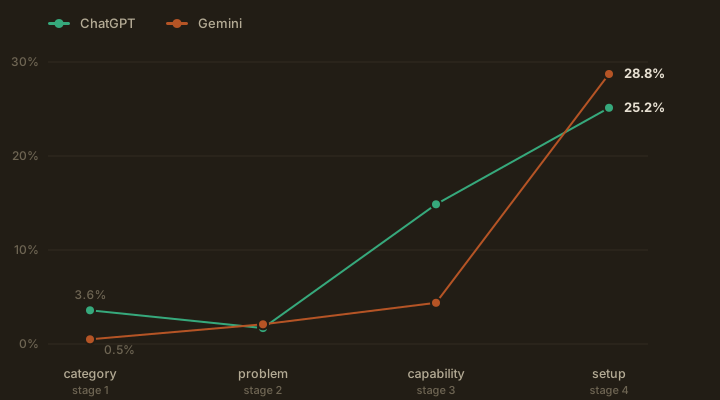
| Stage | What the question asks | ChatGPT | Gemini |
|---|---|---|---|
| 1 | Best tools in the category | 3.6% | 0.5% |
| 2 | We have this problem, what helps | 1.7% | 2.1% |
| 3 | Which tools can do this specific thing | 14.9% | 4.4% |
| 4 | What do you configure to make it work | 25.2% | 28.8% |
I had committed in advance to calling this dead if stage four beat stage one by less than 5 points. It beat it by 22 on ChatGPT and 28 on Gemini.
A quarter of the citations at the stage where somebody is working out whether they can actually run your product, pointing at pages your marketing team has probably not opened this quarter.
Gemini is the stricter test. It barely cites documentation at all until the last stage, then it cites more of it than ChatGPT does. Two engines with different habits arrive at the same place once the question gets specific enough.
The two markets barely overlap
I took the 20 most-cited domains at stages one and two, then the 20 most-cited at stage four. One domain appears on both lists.
| Discovery (stages 1–2) | Implementation (stage 4) |
|---|---|
| kyriba.com, nomentia.com, tesorio.com, highradius.com, gartner.com, anaplan.com, trovata.io, agicap.com, planful.com, iongroup.com, sap.com, drivetrain.ai, dryrun.com, finlens.app, transformance.ai, concourse.ai, fathomhq.com, tispayments.com, treasury.ripple.com, floatapp.com | help.bill.com, docs.oracle.com, suitereport.ai, getaleph.com, cflowapps.com, support.treasurysystems.com, zoneandco.com, help.jirav.com, docs.moderntreasury.com, docs.actuals.io, help.cashflowfrog.com, docs.infor.com, learn.microsoft.com, intercom.help, cashanalytics.com, community.dynamics.com, support.aftership.com, cofficient.co.uk, theaccessgroup.com, floatapp.com |
Kyriba, Nomentia, HighRadius and Anaplan dominate the first list and appear nowhere on the second. When a buyer asks how something actually works, the companies that get cited aren’t necessarily the best known ones.
Look at who stage four names: Bill, Jirav, Cashflow Frog, Actuals, Modern Treasury. Small and mid-market, every one.
None of those placements were bought. A documentation page earns its citation by answering the question that was asked, which is why the smallest vendors in this category are beating the largest ones at the stage closest to a decision. It is the cheapest competitive position here and almost nobody is defending it.
Why the headline number is 25.2% and not 81.8%
Counting every documentation page, including the ERP vendors’ own, stage four reads 81.8% on ChatGPT rather than 25.2%. That is the number this study could have led with. It would have told you almost nothing.
Most of those citations point at Oracle, Microsoft or Infor documentation. That is the platform’s manual: not a page any vendor in the category wrote, owns or can change. A figure built mostly out of Oracle’s docs cannot tell a software vendor what to do on Monday.
I built a control for this before collecting anything. At stages three and four, one question named no ERP while its pair named NetSuite. Everything else about the pair was held the same.
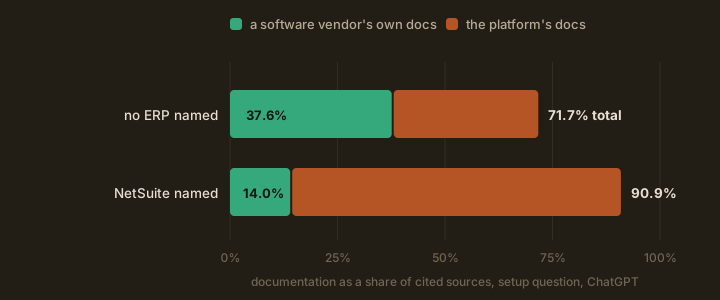
At stage four, naming NetSuite pushes total documentation up 19 points while the share belonging to a software vendor falls by 24. Mention a platform and the model goes and fetches that platform’s manual, which crowds out everybody else’s pages.
The bigger number does tell you one real thing. Counting all documentation, it rises from 10.1% of the pages ChatGPT retrieved at stage one to 64.7% at stage four. The model genuinely does go hunting for documentation once the question gets specific. It is just that most of what it comes back with belongs to the platform rather than to a vendor.
So when you run your own version, ask the setup question without naming your customer’s ERP. Name it and you are measuring Oracle.
What marketing should own
Engineering keeps technical accuracy. Support highlights consistent issues that need clarity. Everything else on a documentation page should be a marketing decision.
- Which questions get a page at all. The setup stage is where retrieval goes looking. If there is no page answering “how do I connect this to our ERP”, there is nothing to retrieve.
- The headings. Retrieval matches on the buyer’s words. Docs are usually written in the product’s words.
- The format. Most documentation is a wall of text because nobody decided it should be anything else. Screenshots, a worked example, a short clip, headings somebody can skim to find their own answer. Those are all choices. They are marketing choices.
- The order. What a reader hits first decides whether they conclude your product fits their stack.
- Whether the docs and the site describe the same product. You can write “built for finance teams” on the homepage, but the setup page shows whether a finance team could get through it alone.
- What happens at the end of the page. Most docs pages end. They do not continue anywhere.
Whether the docs and the site describe the same product is the positioning test. It is why this is a marketing problem rather than a documentation problem. When AI answers the configuration question, the setup page is what it reads.
It also changes the order buyers move in. Somebody can reach a detailed question about how your product is configured without ever landing on your site. The old sequence, where a buyer worked through your messaging before anyone technical got involved, is not guaranteed any more.
Get your own number in five minutes. Open a temporary chat. Ask the setup question a customer would ask about your product, without naming their ERP. Count how many of the cited sources are documentation and how many of those are yours. Then ask your category question and count again. The gap between those two counts tells you which stage you are resourced for.
What I’d test next if this were my product: take the ten most-cited documentation pages in my category and check which of them a competitor owns. Then read my own equivalents next to them. In this dataset the setup stage was a near-empty room for most vendors, which makes it the cheapest stage to compete at.
The eight questions
Word for word, as they were sent. Each ran 65 times on ChatGPT and 65 times on Gemini.
Stage 1 — Category
- What are the best cash flow forecasting software options for a large finance team?
- What software should a corporate treasury team consider for cash flow forecasting?
Stage 2 — Problem
- Our 13-week cash flow forecast keeps missing across multiple entities. What tools can help?
- Our treasury team spends too much time consolidating cash forecasts from many bank accounts. What software could solve this?
Stage 3 — Capability
- Which cash flow forecasting tools can pull intraday bank balances over an API rather than by file import?
- Which cash flow forecasting tools offer a native NetSuite connector for actuals?
Stage 4 — Implementation
- What user roles and permissions do you set up in a cash flow forecasting tool?
- What setup do cash flow forecasting tools require on their side to pull actuals from NetSuite?
Questions 6 and 8 are the NetSuite half of the ERP control. Questions 5 and 7 are their ERP-free pairs.